Today’s post is all about how We Listened to Music in the 1970s: Vinyl, Cassettes and 8-Track Cartridges
If you grew up listening to music in the 1970s, you’ll remember that enjoying your favourite songs was a rather different experience from today.
There were no streaming services, no smartphones and no instant playlists. Instead, we had record players, vinyl albums, cassette tapes and, for some music lovers, the rather unusual 8-track cartridge.
Buying a new record was something special. You could spend ages looking through the albums in your local record shop, checking out the covers and deciding which one deserved your hard-earned money.
Once you got home, there was the pleasure of taking the record out of its sleeve, placing it on the turntable and carefully lowering the needle.
Those were the days!
Let’s take a look back at how people listened to music in the 1970s and the different formats that provided the soundtrack to the decade.
Vinyl Records – The Heart of 70s Music
For much of the 1970s, vinyl records were at the centre of music listening.
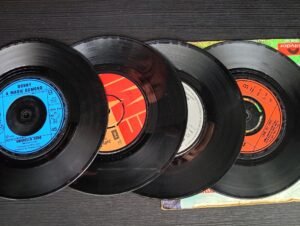
There were two main formats most people will remember: the 7-inch single and the 12-inch LP album.
The 7-inch single was usually bought when you wanted to own the latest chart hit. You might have heard a song on the radio, watched the artist perform it on television or seen it climbing the charts in the music papers.
Then came the trip to the record shop. I remember buying my first 7″ single, it was Nilsson singing Without You. I loved that song.
A new single would usually have an A-side and a B-side, giving you another song to discover. Some B-sides became firm favourites in their own right, even if they never received much radio play.
Albums were a different experience altogether.
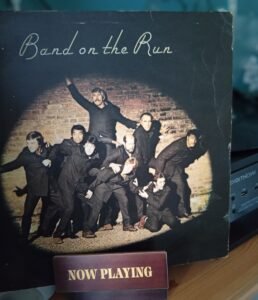
A 12-inch LP gave you a collection of songs rather than just one hit. You could listen to an entire album from beginning to end, discovering the tracks that never made it onto the singles chart.
And let’s not forget the album covers. Some were works of art in themselves, with colourful designs, photographs and gatefold sleeves that made owning the record feel even more special.
Albums such as Dark Side of the Moon, Rumours, Hotel California and Goodbye Yellow Brick Road are still remembered as some of the great releases of the decade.
There was something satisfying about building a record collection and seeing those albums lined up on a shelf.
How We Listened to Music in the 1970s :
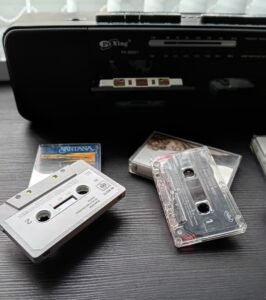
Cassette Tapes – Making Music More Personal
Although cassette tapes were introduced before the 1970s, they became an increasingly important part of how people enjoyed music during the decade.
The compact cassette was introduced by Philips in 1963. Pre-recorded music cassettes followed in 1965, and cassette recorders were soon being incorporated into portable radios and car audio systems.
One of the biggest attractions of the cassette was that you could record your own music.
Imagine listening to the radio and hearing a song you really liked. Instead of having to buy the single, you could record it onto a blank cassette.
Sunday night here in the UK was when the latest top 40 chart songs were played and this was when I and many others would record all the latest chart songs onto blank tapes.
Of course, getting the timing right was important. You didn’t want the radio presenter talking over the beginning or the end of your favourite song!
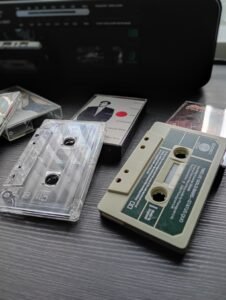
Cassettes also made it possible to put together your own collection of songs. You could choose the tracks, arrange them in the order you wanted and create a personal mixtape.
Perhaps you made one for a friend, or put together a collection of love songs for someone special.
They were also convenient to carry around, and a cassette could be slipped into a bag or pocket much more easily than a record.
And if the tape became tangled or came out of the cassette, many people knew the old pencil trick. A little patience and a few turns of the pencil could sometimes save the day!
The cassette gave music lovers more freedom. You were no longer limited to listening to an album or a single in the order chosen by the record company.
The 8-Track Cartridge – A Format You Might Remember
Not everyone will remember the 8-track cartridge, but it was another format competing for a place in the music market during the 1970s.
Unlike the familiar compact cassette, the 8-track was a larger cartridge containing a continuous loop of tape. It could play through its programmes without needing to be turned over like a vinyl record.
The format was particularly associated with car listening, although it never achieved the same level of popularity in Britain as it did in North America.
It did have a significant presence in the UK music market, though.
According to Official Charts, 1974 was the peak year for 8-track cartridges, with 6.2 million units sold. However, that represented only around 6% of the 109 million albums sold that year. Official Charts
So although the format was available, it was never the dominant way of buying music in Britain.
Some people will remember owning an 8-track player, while others may only have seen the cartridges in shops or in somebody else’s car.
It is one of those formats that reminds us just how much music technology has changed.
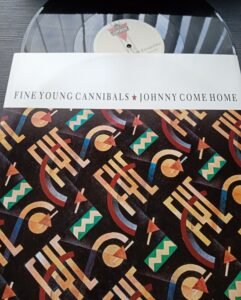
The Arrival of the 12-Inch Single
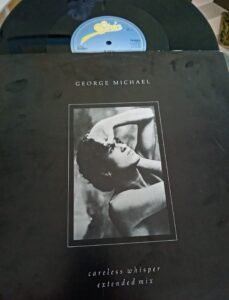
Another interesting development during the decade was the arrival of the 12-inch single.
Official Charts identifies 1976 as the year the 12-inch single reached the UK market, through a reissue of The Who’s Substitute. The format would go on to become an important part of dance music culture. Official Charts
The larger format is particularly interesting to fans of disco, soul and extended versions of popular songs.
If you enjoy this side of 70s music, you can also read my article about NOW That’s What I Call 12″ 70s, which looks at a collection of extended versions from the decade.
Listening to Music Was a Different Experience
One thing that stands out when looking back at the 1970s is how much more physical the experience of listening to music could be.
You had to choose what you wanted to hear before you started listening.
If you wanted to play an album, you had to find the record, take it out of the sleeve, put it on the turntable and turn it over when the first side finished.
If you were listening to a cassette, you had to rewind or fast-forward to find the track you wanted.
And if you wanted to listen to something different, you had to get up and change it!
It might sound inconvenient today, but there was a certain pleasure in owning your favourite music and choosing exactly what to play.
Music was also something people shared. Friends swapped records, lent albums to one another and made cassette recordings of songs they thought somebody else would enjoy.
A record collection could say quite a lot about a person.
How Much Has Changed Since the 1970s?
Today, we can carry thousands of songs around on a phone and listen to almost anything whenever we want.
The technology has made music more accessible than ever, but there is still something special about the old formats.
Vinyl has remained popular with collectors and music enthusiasts, while cassette tapes have their own nostalgic appeal.
For many people, seeing an old record sleeve or finding a cassette they haven’t played for decades brings back memories of a particular time, place or person.
The music might be available online now, but the experience of owning and playing it on the original format was something quite different.
Frequently Asked Questions About Listening to Music in the 1970s
Were cassette tapes popular in the 1970s?
Yes. Although the compact cassette was introduced in 1963, it became increasingly popular during the 1970s. It allowed people to listen to pre-recorded music, make their own recordings and create personal mixtapes.
Were 8-track cartridges popular in Britain?
They were available in Britain, but they never became as dominant as vinyl records. Official Charts records 1974 as their peak year in the UK, with 6.2 million units sold.
When did the 12-inch single arrive in the UK?
According to Official Charts, the 12-inch single reached the UK in 1976, initially in the form of a reissue of The Who’s Substitute.
What was the most common way to listen to music in the 1970s?
Vinyl records were central to music listening during the decade, with 7-inch singles and 12-inch albums being familiar sights in many homes. Cassette tapes offered another way to enjoy and record music.
A Final Look Back at 70s Music
The 1970s gave us an incredible variety of music, and the formats we used to listen to it became part of the memories too.
Whether you spent your pocket money on singles, collected albums, recorded songs from the radio or made mixtapes for your friends, these were all part of enjoying music during the decade.
Technology has moved on, but the songs are still here.
If you enjoy looking back at the artists and songs that made the decade so special, take a look at my other articles on Music of the 70s. You can also download my free A–Z of 70s Music Artists guide, featuring artists who had UK hits during the decade.
Thanks for visiting Music of the 70s!
Frank


